Russian Empire, 1909
A double-headed eagle with posthorns and thunderbolts.
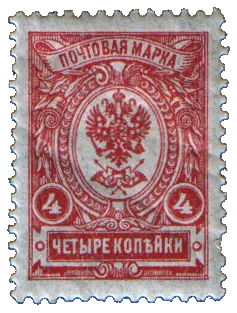
Illustration of a historical stamp for learning, shown at screen size. Not valid for postage.
How to read it
ПОЧТОВАЯ МАРКА and КОПѢЙКИ around the eagle.
- 1ПОЧТОВАЯ МАРКА
- 2ЧЕТЫРЕ КОПѢЙКИ
- Inscription
- ПОЧТОВАЯ МАРКА · ЧЕТЫРЕ КОПѢЙКИ
- Meaning
- “Postage stamp, four kopeks”, in pre-1918 Russian spelling (with ѣ).
- Issued by
- Russian Empire
- Today
- Russia and its neighbours
- Year
- 1909. Arms type of 1909.
- Made by
- Rihards Zariņš (Richard Zarrinsch) (design, died 1939)
One fact
The 1909 arms type was used for the Russian Empire’s everyday stamps; its designer, Rihards Zariņš, designed many imperial Russian stamps.
Source and public-domain rule
Russian official signs of postage. A sign of postal payment of the Russian state; also its designer died 1939. Under Russian law, state symbols and signs (flags, coats of arms, orders, money and the like) are not objects of copyright, and the postal law defines postage stamps as state signs of postal payment. Wikimedia Commons applies the same reading to stamps of the Russian Empire, the RSFSR and the Soviet Union, to which Russia is the legal successor. Applies only to issuers ru and su. Legal sources: Civil Code of the Russian Federation, Art. 1259(6)(2), Federal Law 176-FZ “On Postal Communications”, Art. 2, Wikimedia Commons stamp guidance (community summary, read through a mirror).
Scan: Russia stamp 1909 4k.jpg on Wikimedia Commons (revision 1120313896), licence templates {{PD-RusEmpire}}. Downloaded 2026-10-19, sha256 382fc9d93df7…; cropped and cleaned for this site. Facts checked 2026-10-19 against source 1 and source 2. Research record, not legal advice; a human rights review is pending. Spotted a mistake? Tell us.
